How to do it cost effectively and avoid the downsides.
Most of companies value is in intangible assets. Ideas themselves are not protected. Only the expressions of these in the form of being committed are protected.
Any purchaser is going to want to see IP protections in place. In the US they put budgets aside for this from an early stage (they see it as crucial).
It is an opportunity. It gives you legal protection for your product. It allows you to create and exploit products and markets without other people coming along and exploiting your product or idea. It also helps you to flush out the risks early on so you can pivot early.
Perceived problems include:
Lack of information / expertise
Cost – of acquisition and enforcement
Easy to ignore it – or put it off
A Menu
It is a menu of opportunities. Start with the lower cost, easy, organisational steps and measures.
From that platform consider other options based on:
what and where are the markets?
how long will it / your product last?
what real protection will it provide?
In roughly ascending cost order
Copyright
Copyright is cheap but it can be an asset as soon as it is protected. Primary question is – do you own it?
If you or an employee create something it’s yours – you are the first owner. If not then it becomes very complex. The contractual arrangements need to be watertight.
Use the symbol!
Trade Secrets
Don’t give it away. Reinforce confidentiality amongst those in the know
NDA’s
Trademarks
If you think it will grow long term then protect the name. It is the one form of protection that lasts forever.
Designs
Register them and they are protected. Cheap and generally underused.
Clearance
Beware other people might be there first. Search costs can be high but it depends what you are trying to do.
Patents
Protects the technology at the heart of the invention but it takes a lot longer to build. You also need to disclose your invention to the world in order to obtain a patent. The average cost in the UK is around £5,000-10,000 to file and protect a patent for 20 years but the range is enormous.
Keep all the contacts, records and documents in a safe place. Then if you get into a conflict you will have done all the due diligence and will be ready to prove your case. Tight confidentiality agreements are important. Don’t let IP take a back seat.
SEIS (seed enterprise investment scheme) and EIS (enterprise investment scheme) are tax incentives for those investors who are willing to take a risk on smaller/riskier trading companies.
These tax breaks are to try and plug the gap for smaller enterprises.
SEIS means an early stage company can raise up to £150,000. EIS is available to larger/more advanced companies and can follow and SEIS investment.
There are detailed qualifying criteria. The tax breaks are very good particularly for the seed stage investments but they HAVE to be in exchange for equity.
Deductions from income tax equal to 50% deduction from their income tax bill. They have to be for shares. Annual investment limit is £100,000. For EIS it is up to a million at 30%.
If the shares have been held for over 3 years then capital gains tax does not apply. If they make a loss that loss can be used to set against the income tax bill.
SEIS: The only capital at risk from £100,000 is actually £17,500
Under EIS: £38,500 from the same size of investment.
They have to be invested in new businesses. SEIS is capped at £150,000 total or £100,000 a year. For EIS the cap is £1 million per investor up to £5 million a year. Total cap is £13 million. Excluded activities include: property development, care homes, hotels, and any company that does not own (home grown) the greater part of the value of the IP. Patents/Trademarks/Software all need to be in the company from an early stage in order to protect against this.
It is hard for founders to get these tax breaks in their own companies. This is because if they own more than 30% of the company they can’t be considered. The founder therefore would have to accept going down to a 30% shareholding which is anathema to most founders.
EMI (Equity management incentive) options. These are share options only open to employees of the company. There are maximum limits. The company has be independent; Growth assets of no more than £30 million and less than 250 employees on a less than full time equivalent basis; You also have to have a qualifying trade and the business has to have a qualifying establishment (country).
You need a written agreement, HMRC registration, employee declaration, notification of option grant within 92 days, valuation.
EMI is popular because it has some significant tax advantages – you pay no income tax on the grant.
Automatic entrepreneurs relief gets you 10% tax relief if there is >1 year between the sale and acquisition of the shares.
Restricted shares and growth shares are other options. ESS is another option (Employee shareholder status). These shares are given in exchange for giving up certain statutory employment rights. They are tax free up to £50k on acquisition. However, you do pay income tax on up to £2k.
When the value of the shares is low (ie. seed stage) these kinds of shares can be very valuable.
However, EMI is the most tax efficient if you qualify for it. In the other contexts one has to balance up the risks and benefits of various different options.
Healthcare services, Digital Health, Social Care, Medical products & Services are the four sectors they invest in.
They invest in high quality startups with scalability and the ability to save the healthcare service.
I then asked a question about how to penetrate the system and bring in change.
They feel that in the area of digital health there is going to be another healthcare economy outside the traditional one. The speed on progress and innovation is so great that the old system cannot keep up.
He feels any negotiations with the health service should start with healthcare economics.
By proving that costs will be cut either by efficiency savings or reduction of demand you can engage cash-strapped health services.
Apposite capital’s lifteime investments tend to be in larger companies who are already disrupting in health.
The best place to get seed capital is from rich friends/relatives. Then angel investors. If you choose the right angel you will do well. However, if you get a ‘bad’ angel they won’t be able to help you so much. Then next would be family offices. Grants and VCT’s – they see so many ideas they can help you refine your idea and decide whether or not it is worth pursuing.
The key for VC’s is growth. If you get a business up and running in a high growth sector a VC firm will be interested because even if the investment just keeps up there will ultimately be a good return on the investment. That is the biggest key for a VC firm and it is why the investments they make are so large.
A venture capital firm: Forward partners. Based in London explained what they could offer.
They are a VC firm who back very early-stage investments.
He discussed angel investing and other options,
Crowdfunding – 2-4 times what a VC
Banks
Accelerators – he doesn’t think these are so important
Grant money (get the free money first!)
Optimise your crowdfunding process. You need to think strategically. Getting the money is nor as important as getting it from the right source. List all your options and do your homework to make yourself ready. He talked about what investors are looking for.
Then he talked about why they are so excited about healthtechnology. It is a massive market (containing biotech and healthtech), eventually the two will fuse.
Trends they are interested in:
Mobile trends – people are constantly interacting with them and they are only going to grow as key connectors to customers.
IoT and Sensors – watches and beacons.
AI & Machine Learning – these analyse the data created by the sensors.
He gave the example of Amada in the US and their work with diabetes.
Basically there is big money available for those who have the skill and imagination to build results.
I learned so much from this guy I had to share it with others…
Now is the Time
Why bother starting a lifestyle business. You are sitting on so much value and you want to share that with the world not just make your life easier. you don’t want a checklist business!
‘Big will not beat small anymore. The fast will beat the slow’ — Rupert Murdoch. Even he is aware of it.
Ask yourself: Where can your business be in 12 weeks?
Incumbents should note that there are hidden ‘gun’s’ (startups) in peoples garages which contain bullets with other companies names on them.
As an investor, John Spindler finds the lack of background research by entrepreneurs to be one of the most commonly encountered frustrating problems. To solve this he suggested:
Make 2 columns:
Fact column- 2–3 facts you KNOW about this business plan.
2. Second column- Hypotheses. What things do I need to find out to build this thing?
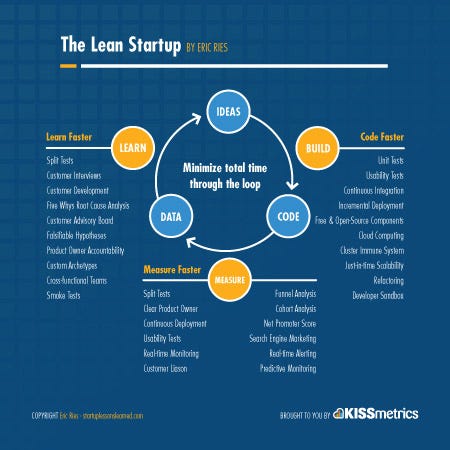
Work out what is your OPPORTUNITY HYPOTHESIS. Build, Measure, Learn. Call it a project rather than a business because it is easier to fail fast. (I like the psychology of this idea and have already found it helpful).
In the experimental stage check your are measuring the right metrics, evaluation of them will lead to excellent execution.
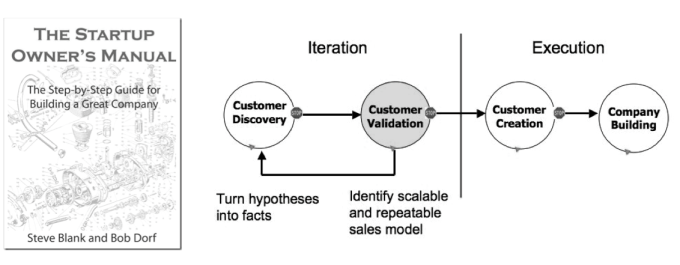
Startup Owners Manual: Steve Blank and Bob Dorf
Don’t build something nobody wants
3 types of advice: validated, negative and useless. (Validated/Negative advice in 8 weeks can be tested to see if it works. Good or bad it will help you. )
However, 95% of advice is useless in the next 8 weeks. Therefore, shelve it because it’s useless to you now.
Lean is just about organising the chaos, reducing waste and risk, providing more learning and a common language. IF your core assumption is wrong you need to test that FIRST. Then you will save yourself a lot of time.
It’s a common language. There is jargon and as soon as you learn it you can communicate with others — be ‘in the club’ as it were.
If you are going to build, do a lot of thinking. Then build the thing that teaches you what you need to learn.
The number one thing an investor will look at is the team. If you can convince a quality person to join you that is a sign of success. If you can recruit a quality army this is your number 1 asset! What quality of ARMY can you recruit? Investors will care about this more than anything else as it is the biggest single determinant of success.
Get OTHERS to validate your product. Your own validation is not that valuable but multiple external validations are.
Testing Hypotheses
A good hypothesis is simple & clear, written as a statement, establishes participants (who), variables (what’s involved) and prediction of an outcome (evidence).
The Pepsi Challenge type scenario is NOT the right first validation exercise. You have to assume that the first answer is wrong. Ask 5 why’s & eventually you might get to the nub of it. AVOID CONFIRMATION BIAS like the plague.
Most people are NOT early adopters in ANYTHING. Most people have habits that are very hard to break.
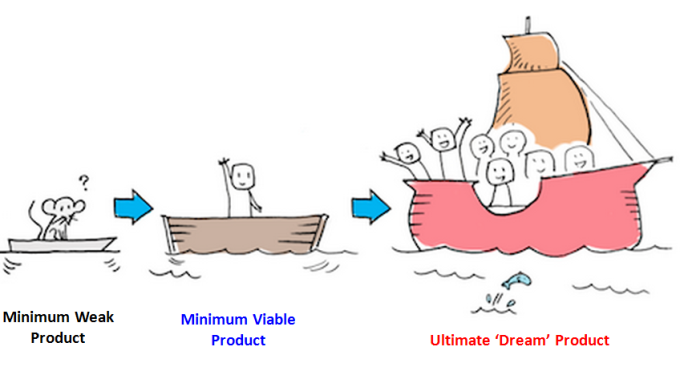
MVP is not a crappy version of the product. It is a prototype. Consierge MVP is legitimate. It can be a simple landing page, it can be a proof of concept, it can be something for people to engage with, it can be a paper prototype, a pitch, fake demo video, or something to help a developer to understand. It is just a way to answer the questions you need to answer.
Consierge means it is not scalable. It’s just there to allow you to learn. Beware, If your hypothesis is circular then its not a hypothesis and you need to think again.
Key assumptions you need to make
At least several other people are working on the same thing right now. How you think this your business idea will work is probably wrong. Your main job is to learn faster than the competitors. That is why the team is the key. It is the process and the people that win NOT the product itself.
The market is not stable and anyone who doesn’t keep moving forward will fall behind.
Call it a project, give it a name, sell something, convince someone else to join, set a goal that will inspire you, live 6 months in the future, fall in love with the problem and not your solution. Follow Peter Thiel’s philosophy as per ‘Zero to One’ (find it on Amazon its a good book.)
Teams
There are two types of teams. Napoleon team — they will follow your every command. The best teams however are people who are smarter than you and can do things you can’t and you bring them on the journey with you. They don’t want to just be footsoldiers for your army.
Bare minimum you need a hipster (domain insight), hacker (builder) and hustler (seller) to succeed.
Paul Graham- You need three things to be a successful entrepreneur — a great team, proof that customers want it and a willingness to do it with minimal money!
Regarding Customers
‘Make something people want’ — Paul Graham, Y Combinator
Avoid wasting too much time trying to change the ‘stuck’ middle who don’t want to innovate because they are very good at using the current system. Are your people your assets or your problem?
Before building your business ask: What problem would someone else solve for me?
Another thought: The number of secrets in the world is roughly equivalent to the number of startups we need.
How did the companies that are currently successful scale. When you scale big you win even if your product is inferior. Unless you can bring 10* value you are unlikely to be able to displace an incumbent. (As per Peter Thiel).
Design Thinking
He would thoroughly recommend doing Stanford’s online course on design thinking (8–10 hours). Emphasise, define, ideate, prototype, test. Do it in groups if you can, it will radically transform your thinking.
‘Kick Ass’ products have evidence that they solve a customers problem in a big market. Focus on the early adopters. People you can beta test with. Commit 5 people. They need to know they are aren’t buying a perfect solution.
They are trying to find a home made solution. They want you to succeed, they will give you their time and honest feedback and you have a relationship of trust. Your mum is not one of these first customers!
Do you know the demographic? Needs and goals? Problems that need solving, Present behaviours? How do they go about solving those problems? Reference group? The behaviours and the psychology are key.
Behaviour Change
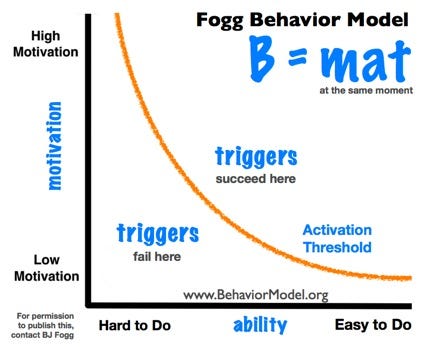
BJ Fogg. Head of behavioural theory at Stanford. B=mat. B=behaviours, m=motivation, a=pre-acquired ability, t=triggers (we are all contextual. We need external triggers to get us to change our behaviour. Every product is a behaviour change. Activation threshold affected by these three things, the triggers have to be enough to get them over the threshold.
Source: B.Fogg (Stanford) Site as per diagram.
Can you make something better than it already is? make something simpler? In an ideal world how would this problem be solved? Better, Simpler or emerging methods?
He suggests we build 5 actual profiles of 5 potential customers (actual people) . The more specific the better: Motivation, Habit , Income, Age, Location, Status, Backstory. Become intimately acquainted with there problems.
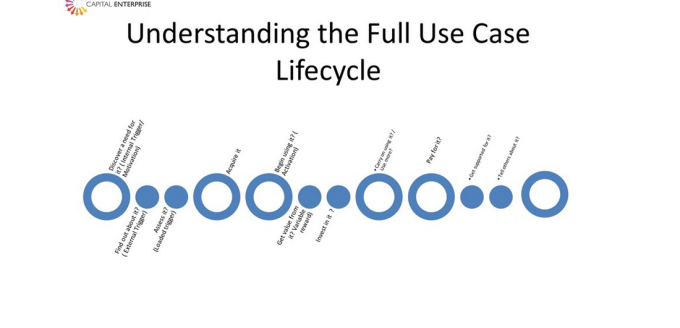
Then understand the full use-case lifecycle.
Source: @capenterprise — John Spindler
What do these personas do when ‘triggered?’
Entrepreneurship is a career. Startups are risky experiments. You don’t have to experiment full time. Start today with what you have.
Do you invest in startups who don’t use lean methodology? Yes but its rarer. Sometimes people just get damn lucky and hit a home run of first base but its the exception rather than the rule and it might not be repeatable.
Then he talked about financing and how ‘founders fit’ and how investors look at these things. Do you have someone resourceful, someone who can do x and y. The team you build now might well not be the team that takes it to the next level. Identify the task in hand and see if the team members can get you there.
Funders and investors must fit. An investor should never distort the function of the startup because this is your task. You have the hands on the controls. They are investing in you!
Suggested reading: Moms test by Rob Fitzpatrick, Running Lean by Ash Maurya and Lean Startup by Eric Ries.
This article came out of notes I took on a talk by @capenterprise at the first NHS clinical entrepreneurs pit stop – The beginning of a new journey. Or see my medium blog
Good legal governance leads to credibility. Helps us to maximise value and avoid costly disputes.
£130,000 to get to court
£600,000 to take a case through the IP court!
Good examples of Patents that have succeeded: Ermil who developed the can pull and then sold it to coca cola.Before long he was making a lot of money with his few cents take per can!
Is your idea actually YOURS? If it is can you obtain freedome to operate and therefore commercialise the idea. In order to do thsi it will need to be protected.
Learning from Lord of the Rings. Keep it secret. Keep it safe. Or more correctly keep it confidential, keep it safe.
As soon as you start to disclose the core of your stuff you need a NDA in place. As good practice you should still be trying to minimise the information you are giving (the secret sauce as it were). When you come to contracting make sure that there are things in place to stop people getting the full picture (drip feed the information).
Patents:
Consider if it is needed, can you afford it, can you afford to defend it, is it patentable.
If you do need one write it yourself because someone else won’t know your idea as well as you!
To Incorporate or not?
Sole trader, partnership or PLC? What to choose. There are advantages and disadvantages to each. If you do incorporate you have protection but you have to decide:
How you divide up the shares in the company.
Creator, founder, entrepreneur, manager, funder. Look at the contributions now and future contributions and then decide how to divide up the stakes. You are looking to make up an equity split.
Documents, articles, officers, directors etc. Lots of things to think about.
What is the rule book – governance of the corporate structure.
Shareholders agreements whill cover all of this. What are the rules. Who are the directors and who are the shareholders. governance, IP, how to transfer shares, dispute resolution, restrictions and leaver provisions are all in here.There needs to be a structure to protect the shares.
Its about building a contractual mechanism to resolve these disputes in order to avoid a court case later on.
Employees
Must have contracts but can have policies which fit everyone.
Your employess represent an operational risk. HR can be tough!
Confidentialitiy, IP ownership, Restrictions and Policies, One size fits all.
Our IP
National contracts do not talk about IP however, local policies might say that individuals do not own IP if they are working in the context of their trust.
Tony suggested potentially writing to the employer explaining that you are building something in your own time and that it is your own IP but also being willing to work with the NHS to make things better for patients.
Roger explained that it is a negotiation.
The whole room is massively engaged at this point
As a businessperson you should also sign up to an LPA just in case something happens to one of the founders. Make wills which tie in your shares, Assignment of intellectual property and other agreements.
Business Model and Contracts
SAP (standard operating procedures) and quality control – document this so you can demonstrate ‘due process’. Also trading contracts whether they be NDA’s, standard terms, bespoke contracts. Don’t sign it if you don’t understand it. and contracts
Bespoke contracts. key terms, compliance, reflect – make sure it fits with your business model and insurance cover. Negotiate.
Joint ventures are particularly important to get right. Define contributions, milestones, outputs. Licences – Get the scope and the outputs correct.
A contract should be a ‘living document’- it needs to keep up to date with the business!
Financing Options
Venture capitlists – are they scary? The key is to find the right VC. If they don’t fit don’t work with them.
Toby Stone just explains the what, how and when of accelerators.
In a nutshell they should be a good fit for your business before you join one. You shouldn’t do one if your main need is simply capital. They may take equity or some other parallel. They provide you with mentors who have been through it before. Ideally this mentor and your investors should have specific knowledge but also general knowledge that you don’t have and can benefit from.
An accelerator like an investor is way more than just the money and you should spend time trying to find a good fit. There are some specialised ones.
SeedDB is a great site that lists them all but they are constantly changing. There are some more specialised ones like Healthbox and TechStars
A note on Crowdfunding: Seedrs will manage the crowfuding investors for you, Crowdcube won’t.
One of the best ways to fill your funding round is to use different platforms at different times to lure in different kinds of investors at the right times. For instance Kickstarter is really useful to raise awareness if you have a hardware product. Then when, your round is filling up it gives you momentum and clout when talking to angels, however, this is only one example and every different situation will require a different strategy.
‘Make something people want’ – Paul Graham, Y Combinator
Avoid wasting too much time trying to change the ‘stuck’ middle who don’t want to innovate because they are very good at using the current system. Are your people your assets or your problem?
Before building your business ask: What problem would someone else solve for me?
Another thought: The number of secrets in the world is roughly equivalent to the number of startups we need.
How did the companies that are currently successful scale. When you scale big you win even if your product is inferior. Unless you can bring 10* value you are unlikely to be able to displace an incumbent. (As per Peter Thiel).
Design Thinking: He would thoroughly recommend we all do Stanford’s online course on design thinking (8-10 hours). Emphasise, define, ideate, prototype, test. Do it in groups if you can. Great course
‘Kick Ass’ products have evidence that they solve a customers problem in a big market. Focus on the early adopters. People you can beta test with. Commit 5 people. They need to know they are aren’t buying a perfect solution.
They are trying to find a home made solution. They want you to succeed, they will give you their time and honest feedback and you have a relationship of trust. Your mum is not one of these first customers!
Do you know the demographic? Needs and goals? Problems that need solving, Present behaviours? How do they go about solving those problems? Reference group? The behaviours and the psychology are key.
BJ Fogg. Head of behavioural theory at Stanford. B=mat. B=behaviours, m=motivation, a=pre-acquired ability, t=triggers (we are all contextual. We need external triggers to get us to change our behaviour. Every product is a behaviour change. Activation threshold affected by these three things, the triggers have to be enough to get them over the threshold.
Source: B.Fogg (Stanford) Site as per diagram.
Can you make something better than it already is, make something simpler. In an ideal world how would this problem be solved. Better, Simpler or emerging.
John suggests we build 5 actual profiles of people. The more specific the better. Motivation, Habit , Income, Age, Location, Status, Backstory.
Understand the full use-case lifecycle.
You need a hipster (domain insight), hacker (builder) and hustler (the first two work for him for free!).
Source: Capital Enterprise – John Spindler
What do these personas do when ‘triggered?’
Entrepreneurship is a career. Startups are risky experiments. You don’t have to experiment full time. Start today with what you have.
Suggested reading: Moms test by Rob Fitzpatrick, Running Lean by Ash Maurya and Lean Startup by Eric Ries.
Brilliant start to the clinical entrepreneur programme. @Tonyyoung and @theonlytoby introduce the programme (below)
Building a culture of entrepreneurial strength should be at the heart of what we are doing.
John Spindler @capenterprise – Lean Startup
Why bother starting a lifestyle business if you are a doctor. You have so much value and you want to share that with the world not just make your life easier. you don’t want a checklist business!
‘Big will not beat small anymore. The fast will beat the slow’ – Rupert Murdoch. Even he is aware of it.
Where can your business be in 12 weeks?
‘There are hidden gun’s in peoples garages which contain bullets with other companies names on them.’
As an investor, John Spindler finds the lack of background research by entrepreneurs to be one of the most commonly encountered frustrating problems.
2 columns:
Fact column- 2-3 facts you KNOW about what you about about do with this business.
Second column- Hypothesis. What things do I need to know to build this thing?
What is your OPPORTUNITY HYPOTHESIS. Build, Measure, Learn. Call it a project rather than a business because it is easier to fail fast. Like the psychology of this.
Experimental stage, metrics, evaluation leads to excellent execution.
Don’t build something nobody wants!
3 types of advice: validated and negative (in 8 weeks you can test it and see if it works. Good or bad it will help)
95% of advice is useless in the next 8 weeks. Shelve it because it’s useless.
Lean is just about organising the chaos, reducing waste and risk, providing more learning and a common language. IF your core assumption is wrong you need to test that FIRST. Then you will save yourself a lot of time.
It’s a common language. There is jargon and as soon as you learn it you can communicate with others – be ‘in the club’ as it were.
If you are going to build do a lot of thinking. Then build the thing that teaches you what you need to learn.
The number one thing an investor will look at is the team. If you can convince a quality person to join you that is a sign of successfulness. If you can recruit a quality army this is your number 1 asset! What quality of ARMY can you recruit? Investors will care about this more than anything else as it is the biggest determinant of success.
Get OTHERS to validate your product. Your own validation is not that valuable but multiple external validations are.
A good hypothesis is simple & clear, written as a statement, establishes participants (who), variables (what’s involved) and prediction of an outcome (evidence).
The Pepsi Challenge type scenario is NOT the right first validation exercise. You have to assume that the first answer is wrong. Ask 5 why’s eventually & you might get to the nub of it. AVOID CONFIRMATION BIAS like the plague.
Most people are NOT early adopters in ANYTHING. Most people have habits that are very hard to break.
MVP is not a crappy version of the product. It is a prototype. Consierge MVP is legitimate. It can be a simple landing page, it can be a proof of concept, it can be something for people to engage with, it can be a paper prototype, a pitch, fake demo video, or something to help a developer to understand. It is just a way to answer the questions you need to answer.
Consierge means it is not scalable. It’s just there to allow you to learn. If your hypothesis is circular then its not a hypothesis.
Key assumptions: At least several other people are working on the same thing right now. How you think this your business idea will work is probably wrong. Your main job is to learn faster than the competitors. That is why the team is the key. It is the process and the people that win NOT the product itself.
The market is not stable and anyone who doesn’t keep moving forward will fall behind.
Call it a project, give it a name, sell something, convince someone else to join, set a goal that will inspire you, live 6 months in the future, fall in love with the problem and not your solution. Follow Peter Thiel’s philosophy as per ‘Zero to One’ (find it on Amazon its a good book.)
Don’t call it a business because you will overprotect it. Call it a ‘project’. Get people to devote time to your thing.
There are two types of teams. Napoleon team – they will follow your every command. The best teams however are people who are smarter than you and can do things you can’t and you bring them on the journey with you. They don’t want to just be footsoldiers for your army.
Paul Graham- You need three things to be a successful entrepreneur – a great team, proof that customers want it and a willingness to do it with minimal money!
Then questions:
Do you invest in startups who don’t use lean methodology? Yes but its rarer. Sometimes people just get damn lucky and hit a home run of first base but its the exception rather than the rule and it might not be repeatable.
Then he talked about financing and how ‘founders fit’ and how investors look at these things. Do you have someone resourceful, someone who can do x and y. The team you build now might well not be the team that takes it to the next level. Identify the task in hand and see if the team members can get you there.
Funders and investors must fit. An investor should never distort the function of the startup because this is your task. You have the hands on the controls. They are investing in you!





















 Matt Stammers' Blog
You must be logged in to post a comment.